
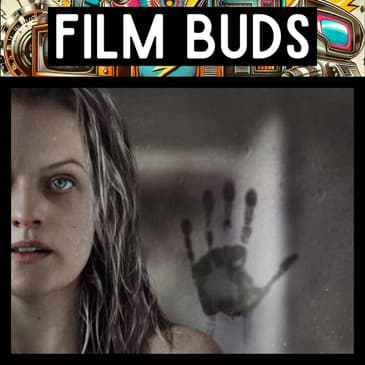
Halloween Films: Part 3 (3 of 7). Henry loses his sanity with 2020's The Invisible Man (currently available via Amazon Prime). Get the full show now @ FilmBuds.Bandcamp.com!
[00:00:00] 244, Let's get to The Invisible Man 2020, written and directed by Leigh Whannell, stars Elizabeth Moss, Oliver Jackson-Cohen, Harriet Dyer, Aldis Hodge, Storm Reid.
[00:00:19] And the synopsis is, when Cecilia's abusive ex takes his own life and leaves her his fortune, she suspects his death was a hoax. As a series of coincidences turn lethal, Cecilia works to prove that she's being hunted by someone nobody can see.
[00:00:41] For anyone who has listened to the show for a long time knows I love The Invisible Man, the original Invisible Man with the bandages around his body, the trench coat. I just love that original film.
[00:00:55] I wasn't going to originally talk about this movie, but having talked about it on the Wolfman review in the first part of his collection, plus Leigh Whannell is releasing Wolfman in January.
[00:01:12] So, good a time as any to revisit this. I know when this was announced that I, like most, I think, were very skeptical.
[00:01:25] It wasn't just a new adaptation, it was a reimagining a modern adaptation, and I was immediately thinking, okay, it's being done by Blumhouse.
[00:01:37] It's probably going to be terrible. It's going to ruin the overall concept and appeal of The Invisible Man.
[00:01:48] Luckily, though, this was in good hands.
[00:01:52] I had seen Upgrade, and Leigh Whannell also had a big part in the creation of the Saw franchise.
[00:02:02] Right off the bat, I really, really liked this movie.
[00:02:06] It's one of Blumhouse's best movies, I think, in the last decade.
[00:02:11] And easily one of the best, quote-unquote, monster movies in this realm.
[00:02:17] Whether it's a classical adaptation, like I just did with Victor Frankenstein, or a reimagining like this one is.
[00:02:24] There's a time and place for both, but this one is vastly superior.
[00:02:31] Elizabeth Moss, I saw her first in Mad Men, which remains one of my favorite shows, and I've loved all of her work ever since.
[00:02:39] I think she's a fantastic actress.
[00:02:41] I try and watch whatever she does.
[00:02:45] She's really, really good in the movie.
[00:02:48] Everybody's good.
[00:02:51] But what makes this movie what it is, the writing, the direction, the editing, cinematography, it's so strong.
[00:02:59] It's so sharp.
[00:03:03] The commentary of, I mean, it really came right after or during the Me Too movement, so it for sure speaks on all of that.
[00:03:13] But to me, at least, in a very potent, resonating way, it doesn't feel put on or forced or artificial.
[00:03:19] The surrounding story, you know, the overall story of Elizabeth Moss having this very abusive, powerful boyfriend, very rich and very well-connected.
[00:03:34] For one, the opening scene sets the stage for everything.
[00:03:38] Like, I was immediately invested.
[00:03:40] The opening credits, even, with the waves crashing against the rocks, but that very, very quiet, eerie opening of her trying to escape.
[00:03:50] We see the secluded mansion, but she is able to escape and thinks she's off scot-free.
[00:04:00] And then also, she finds out that he commits suicide, or so people think.
[00:04:06] But, of course, that's not actually the case, which she suspects.
[00:04:13] That narrative of her really portraying so well, I mean, I've never gone through this, thankfully.
[00:04:18] I have known people in this sort of situation, not entirely, but close to at least, in one way or the other,
[00:04:25] of trying to escape this abusive, controlling life of this partner.
[00:04:31] She's not even married to him, but still he is able to maintain power over her.
[00:04:36] And that idea of, even though we don't really see him for most of the runtime, that's sort of where the fear comes from.
[00:04:44] Is he watching me?
[00:04:46] Is he stalking me?
[00:04:47] Could he be in my friend's house right now?
[00:04:50] Could he call me?
[00:04:50] Could he find me in this hospital room?
[00:04:54] Et cetera, et cetera.
[00:04:57] And not only that, but because he is wearing this invisibility suit, her claim to sanity, to her defense, gets worse and worse.
[00:05:10] And in the long run, it's very effective in how hopeless she becomes at a certain point.
[00:05:16] Like, no one believes her.
[00:05:19] The Invisible Man is constantly setting her up with one of the best scenes in the movie.
[00:05:25] Like, one of the best, oh my god, shocking moments that I've seen in years is the framing her for murder.
[00:05:32] When she's sitting across the woman in the restaurant.
[00:05:38] The other woman sees a floating knife right next to Elizabeth Moss.
[00:05:44] The Invisible Man slits her throat and then immediately puts the knife, the bloody knife, in Moss' hand.
[00:05:52] And then she's just caught in public with a bloody knife on her hand and the only possible person that could have realistically killed the person sitting across from her.
[00:06:02] Like, that was in the theater.
[00:06:04] I was like, oh my god, that was so good.
[00:06:07] And what makes it even more effective, more so than just the surface level killing, is it makes her case that much less believable.
[00:06:19] Because obviously, you know, in a realistic situation, if you saw that, oh yeah, sure, a guy in an invisibility suit did that.
[00:06:27] Right, you're crazy.
[00:06:30] On top of that, some of the other moments, little moments that make her think she's losing her sanity.
[00:06:36] For example, the stove manipulation when she's cooking something, she walks away and then the boyfriend turns it on and causes a fire.
[00:06:47] Or when she's in the girl's bedroom of her friend and the girl gets knocked away and then the father thinks, well, obviously it was you.
[00:06:57] It must have been you, which we know that's not the case.
[00:07:00] Going back to the technical aspects of the movie that make it what it is, how they use, I don't like using these very more academic terms in movies,
[00:07:13] but like the negative space in this, in which the camera will just have these very slight, easy pans from left to right or somewhere in a room where Elizabeth Moss is.
[00:07:26] Because we and she, not just us, we think, is he in there with her right now?
[00:07:34] Or we'll see a open window have some breeze flow through it.
[00:07:40] Or we'll see a footprint.
[00:07:45] And it's easy for a situation like that, if done poorly, to come across as manipulative for the audience.
[00:07:53] Because we're like, okay, he's probably not there.
[00:07:56] Like, obviously we're looking at nothing, but she feels the same way.
[00:08:00] So we're with her intimately with that fear.
[00:08:06] Plus, even from a budget level, that's a really, if done well as it is here, that's a really easy way to maintain a low budget.
[00:08:16] The look of the invisible man himself, really simple, but really memorable and striking.
[00:08:25] The glitchy aesthetic to it, I love.
[00:08:29] When he's out in the rain or one of the best jump scares, visually, is when she's up in the attic and she throws the white paint.
[00:08:37] And then his silhouette is partially covered by the paint and there's that realization.
[00:08:44] The hallway massacre is another highlight when she's being dragged through the hallway and the security guards are there.
[00:08:53] And one by one, the invisible man takes him down.
[00:08:58] For example, the guy who's holding the gun and he grabs it, puts it to the guard's knee and fires.
[00:09:08] Or holding the gun and it looks like a floating gun pointing at a guy.
[00:09:13] There are just countless moments of really vicious but effective violence.
[00:09:18] Not necessarily horror, but just, it's not an action movie, but what action is there, it's good.
[00:09:27] One of the only moments that I think some people could find a little goofy is when she's fighting him in the house.
[00:09:35] And she's being thrown around by seemingly nothing.
[00:09:38] And she's just wailing her arms and punching and all that.
[00:09:43] I think at first, or in the trailers, that may have been in the trailers.
[00:09:49] Sure, I mean, it's maybe a little silly, but in the context of the movie, I don't really mind that.
[00:09:55] That wouldn't be my favorite moment.
[00:09:58] But in terms of the effects, I'd say it's impressive for how they pulled that off.
[00:10:06] Also, the moment when she realizes that she's pregnant.
[00:10:12] And sure, it's maybe a little unrealistic in terms of the practicality, if that was how that would be done.
[00:10:18] But it's still a fairly unsettling idea to think if that was you.
[00:10:26] The score is very good by Benjamin Walfish, if I'm saying that right.
[00:10:30] He's a great composer in all respects, but he's done a lot of horror films over the last 10 years.
[00:10:38] One of the only things that doesn't make it a 5 out of 5 as of now is the final act goes on a little too long.
[00:10:52] And I appreciate that the final chunk is about her regaining her power and control, taking down the boyfriend and moving on.
[00:11:01] That's a very good message to have.
[00:11:05] But the structure of it, when there's that final fight, I think it's at the hospital or the rehab place and the house.
[00:11:13] That almost feels like it kind of comes to a conclusion.
[00:11:18] And then there's a pretty extended scene at the boyfriend's house where they're having dinner and things go nuts.
[00:11:25] That kind of takes the adrenaline rush out that we've just had.
[00:11:32] Especially on rewatch, I'm just waiting for that final takedown.
[00:11:38] Not a big deal at all.
[00:11:40] Very minor problems in the big scheme of things.
[00:11:44] So yeah, I really can't say enough about it.
[00:11:47] We need more reimaginings like this that make the movie its own or that director makes the movie their own.
[00:11:57] That one is a heavy 4.5 out of 5.