
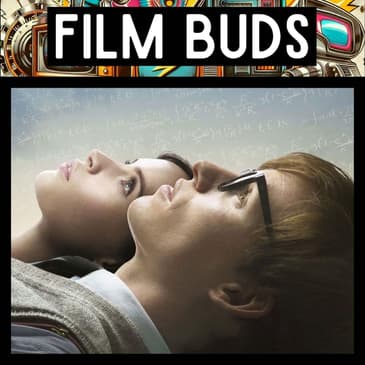
As the 1st bonus review for the Tom Hooper premium podcast, Henry makes an amazing discovery in Eddie Redmayne's The Theory of Everything (currently available for digital purchase / rental). Get the full show now @ FilmBuds.Bandcamp.com!
[00:00:00] 222. Let's get to a bonus review, the first of three for the Tom Hooper Premium Podcast, which is The Theory of Everything.
[00:00:12] Now this is one that has no relation to Tom Hooper. I wanted to cover it because it is one of Eddie Redmayne's biggest performances.
[00:00:22] And I couldn't really think of another upcoming show that I would include it on. So hopefully it makes sense to put it in this collection.
[00:00:33] So it came out in 2014, is directed by James Marsh, stars Eddie Redmayne, like I said, Felicity Jones, Emily Watson, Charlie Cox.
[00:00:47] And the synopsis is, Stephen Hawking gets unprecedented success in the field of physics, despite being diagnosed with motor neuron disease at the age of 21.
[00:01:02] Well, this one really launched, I mean, Eddie Redmayne had already been in a few things like My Week with Marilyn, Les Mis.
[00:01:12] I also like biopics, and the world of science as well. I've seen it a handful of times over the years.
[00:01:23] It's always at about the same level. I don't think it's a masterpiece, but I think it's very, very good. Very solid.
[00:01:31] The main reason for that is Eddie Redmayne. His physical transformation is pretty astounding.
[00:01:40] I really never questioned that in the context of the movie, he was going through this, like it feels as authentic as I think it could.
[00:01:49] And I know Stephen Hawking did come out and say it felt like I was watching myself on screen.
[00:01:57] That's an insane achievement.
[00:01:59] But even if he hadn't said that, it's still an amazing and really iconic role.
[00:02:06] I think it'll always be one of his, if not the defining role for Eddie Redmayne in his career.
[00:02:13] I think what I really, and it's on rewatches that I really noticed this,
[00:02:19] what I really appreciate about the movie is that it's not just all about him being diagnosed with motor neuron disease.
[00:02:30] Really, the main focus is the marriage.
[00:02:33] It starts with that of the meeting, the meet cute, and then the final moments of the movie are not about him struggling or anything with health or medical problems.
[00:02:43] It's our family.
[00:02:47] Because I timed it, it's about, I think, past the first act, maybe 30, 40 minutes in when he actually does get diagnosed.
[00:02:56] So that first part is him just in school.
[00:02:58] It's him meeting Felicity Jones or Jane.
[00:03:02] And you just getting to spend time with him.
[00:03:06] It doesn't feel like it has that exploitative setup of, or construction of saying,
[00:03:12] all right, we're going to show you how bad this hit him and et cetera, et cetera.
[00:03:15] It doesn't feel like that at all.
[00:03:16] It feels very thoughtful and kind.
[00:03:21] Of course, Stephen Hawking was brilliant, one of the most brilliant people of all time.
[00:03:26] And considering he did get diagnosed with this disease at 21 and he lived decades when they said he would only maybe live two.
[00:03:35] That in and of itself, even if he hadn't done all the other scientific things that he did, it still would have been unbelievable.
[00:03:46] The little teases of him struggling with his movements, like when he's tripping on the stairs or knock something off the table,
[00:03:56] that I think is done very subtly.
[00:03:58] But especially if you know what happened to him eventually, you see how tragic that would be.
[00:04:05] But to him at the time, it doesn't seem like much.
[00:04:08] Like, oh, wait, my leg is a little funky today.
[00:04:10] Or, yeah, I knocked a mug off the desk.
[00:04:13] Oops.
[00:04:16] But you know what's coming.
[00:04:18] And it is so tragic when there's that scene of he is diagnosed and they say, well, you may have a lot of amazing thoughts and ideas in your head, but sooner or later, no one is going to be able to hear them because you're not going to be able to speak on your own.
[00:04:33] And you're going to be able to hear them.
[00:04:35] And you're going to be able to hear them.
[00:04:35] And you're going to be able to hear them.
[00:04:36] And you're going to be able to hear them.
[00:04:38] On top of all the stuff I already said about Red Bane, that overall development of him getting progressively worse also feels very authentic.
[00:04:49] You know, where he does have a family eventually with Jane and he's struggling to get up the stairs and he sees his kid, his baby at the top of the stairs and he can't really get to him.
[00:05:02] Or he's trying to eat with a spoon and he always drops it and people noticing and him being frustrated with himself.
[00:05:12] One of the more interesting things about the narrative, and it sort of almost relates to the Danish girl when Alicia Vikander was struggling with wanting to stay with Eddie Redmayne in that film.
[00:05:28] Jane does meet this church choir teacher about halfway through and then eventually that's who becomes her husband.
[00:05:41] The back and forth of her conflict of always wanting to stay completely faithful and to help and support Stephen, but then wanting to have her own freedom of life.
[00:05:54] And then also Stephen Hawking realizing, all right, what am I doing to my wife?
[00:05:59] I see that she wants to be with this person.
[00:06:02] She supported me for years and years.
[00:06:05] We've had kids together.
[00:06:06] Am I holding her back from being happy or am I in a way trapping her from really living the life she wants to?
[00:06:15] And the other man is played by Charlie Cox of Daredevil fame.
[00:06:20] Great actor.
[00:06:20] I like how they present.
[00:06:24] I can't speak to how truthful it is to what all happened.
[00:06:28] I can't say anything to that.
[00:06:30] But I like in this how they present him as really not a bad guy.
[00:06:36] He just happened to meet Jane.
[00:06:39] They started to fall for each other.
[00:06:41] There was no real sneaking around or trying to manipulate Stephen or trick him.
[00:06:47] They even would have dinner together at their house or a church and those conversations of God versus science and Stephen Hawking usually making the jokes or the points that make sense.
[00:07:03] But even so, Charlie Cox's character still supporting him because obviously he knows the kind of person Stephen Hawking is and seeing what he's going through.
[00:07:15] So as a viewer, there is that love triangle where there's not...
[00:07:19] Obviously, there shouldn't be no affairs or anything going on no matter what.
[00:07:24] But I like how you're never really hating anybody.
[00:07:29] Some of the more touching scenes...
[00:07:32] I mean, it's a very emotional movie for a lot of reasons.
[00:07:35] And I think it...
[00:07:36] Whether it's for Stephen Hawking or for Jane's position, maybe if you've seen someone go through a decline health-wise and maybe even being that caregiver, that's a relatable aspect of it as well, I think.
[00:07:50] The scene around the time when Jane and Stephen separate, there's that moment when she's at some sort of hospital or school or something and she's holding up the chart of colors that have corresponding letters before he gets the electronic voice machine.
[00:08:11] They're really both at their breaking points.
[00:08:15] Like, he's having trouble.
[00:08:17] Jane is struggling to stay committed.
[00:08:20] They're both being pulled in all these different directions.
[00:08:25] When they finally do give or create the electronic machine, voice machine for Stephen Hawking and he is finally able to communicate more easily and he speaks in the way that most of the world knew him to speak.
[00:08:38] Like, the decision when he has the...
[00:08:45] Whether it's a stroke or what, and Jane has to make the decision to do the medical procedure on his throat.
[00:08:54] One of the more...
[00:08:55] I think in terms of what a lot of people would go through, I think, is when he does first get diagnosed and he's still walking, but he's stumbling and his arms and legs are starting to decline.
[00:09:08] And Jane goes up to him in that common room and says, if you don't get up and play a game of croquet with me, I'm never coming back.
[00:09:19] In the end, yeah, sure, he's going through what no one could imagine, but she's still there wanting to support him and she needs something in return.
[00:09:27] You know, she can't just be blown off.
[00:09:31] And deep down, I think he would feel the same way.
[00:09:37] Technical strengths, it looks great.
[00:09:39] I love the cloudy, glassy, old-fashioned visual style.
[00:09:47] The score by the late Johan Johansson, who also did Sicario, Arrival, Prisoners, and some others.
[00:09:55] A fantastic score, RIP.
[00:10:00] And it's very unlike most of what he used to do, which is what I love in composers when, whether it's their choice or a director's choice,
[00:10:07] I love when composers will do the complete opposite of what we know them to be.
[00:10:15] The final moments at the end, going back to what I said at the beginning, Jane and Stephen being together and looking at their children and saying, look what we made.
[00:10:28] The flirtatious nurse of Stephen is very funny and charming.
[00:10:36] And lastly, I think one thing that really feels true to how a human being would be thinking or maybe dreaming if you were in this situation is that scene when he steps up from his wheelchair or from the chair and he's like his old self again.
[00:10:53] And then he is big and strong and healthy and then it cuts back to him being in the wheelchair and he just has that moment of fantasy.
[00:11:04] Really one of the only issues in the whole thing is maybe the third act, maybe last 40 minutes or so become a little long, not really repetitive, but I think it takes a while to get to certain points where you can sort of see where it's going.
[00:11:22] And so I'm definitely still invested and I'm very emotionally engaged, but sometimes my interest wanes here and there.
[00:11:33] Not a huge deal.
[00:11:35] If that's one of its only problems, that's good.
[00:11:40] Felicity Jones overall, I've already talked about her a lot, but she's amazing in this.
[00:11:45] One of her best roles to date.
[00:11:49] So that one is a light four and a half out of five.